
By MARIE PANTON
of Episcopal Life
LITURGICAL CHURCHES are an anomaly for most people in the United
States.
The Rev. Stephen Smith, rector of Christ Church in Hudson, Ohio,
knows that most visitors who walk into Episcopal churches are
not traditional Episcopalians. "The image they get about Christianity,
in general, is from their televangelist," he says. "Since we are
not like that, people are confused. So to welcome people into
our midst, we have a big job to do."
The job is a challenge, as more and more parishes recognize as
they become intentional about their welcome. Trained greeters,
clearly marked directional signs, accessible ramps or elevators,
and proper lighting become important physical proofs of welcome.
But the more subtle signs -- like avoiding "code" language and
Anglican jargon -- are just as important for people to make them
feel more comfortable during the service.
When an individual takes the time to find us and then show up
at our door, we need to be ready to welcome them, says the Rev.
Charles Fulton, director for congregational development at the
Episcopal Church Center.
"The real difference between a welcoming congregation and a non-welcoming
congregation is primarily whether they are there for themselves
or for the visitor," says Fulton. "We need to realize that we
put up a lot of hurdles, even when we are trying to be friendly.
"We use a lot of `code' language; we do our liturgy for ourselves
and not for our visitors. Welcoming is not just something we do
because we hope to have a visitor. ... Reaching out to those who
don't yet know God's reconciling love is not just another 'thing;'
it's the thing for Christians."
One of the ways Smith's parish reaches out is through its web
site (www.christchurchhudson.org). The parish is located in a
transient, suburban, community -- 40 percent of the population
in Hudson will move within five years, according to recent research.
"While we have people moving away, we also have them coming in,
so we have to be welcoming," says Smith. He counts on the web
site to help attract transients and says newcomers tell him they
use it to find the church.
Shirley Eells, a member of Christ Church for 22 years, keeps track
of all the names of the newcomers and personally welcomes each
of them. "I just like to know everybody," says Eells. "I think
everyone should feel welcomed. ... There should be a connectedness
in a church that people feel compelled to want to attend. ...
Sometimes a church is the first connection you have with the community
that you live [in]."
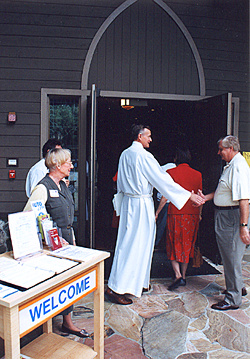
 The Rev. James Brooks-McDonald uses a personal approach to establish
this connection. "I like to welcome people as they come in to
the church on Sunday morning," says Brooks-McDonald, rector of
St. Stephen's Church in Schenectady, N.Y., for 13 years. "If I
can shake hands with all the people when they come in, it goes
much farther in welcoming than at the end of the service."
The Rev. James Brooks-McDonald uses a personal approach to establish
this connection. "I like to welcome people as they come in to
the church on Sunday morning," says Brooks-McDonald, rector of
St. Stephen's Church in Schenectady, N.Y., for 13 years. "If I
can shake hands with all the people when they come in, it goes
much farther in welcoming than at the end of the service."
The church also prints the day's entire service in a booklet that
is distributed to each member of the congregation, relieving worshipers
of the need to leaf through different sections of the Book of
Common Prayer.
"The more direction we can give, the more comfortable people feel," Brooks-McDonald says. Name tags are a catalyst for people to get to know each other. "As soon as a person visits one time and fills out a visitor's card, we make a name tag for them while encouraging everyone else to wear theirs so that they can be quickly introduced," he says. A bulletin board hangs with the photos of all the families and individuals, with their names. "When you are new in a parish, you sometimes hear names without seeing the person's face. A new person can look at the board and find out who you are."
Ministry results in new members
Church of the Epiphany in downtown Washington, D.C., faces a number
of challenges in its outreach and welcome. Riots, violence, drugs
and a sliding economy have taken a toll on many neighborhoods
in Washington.
Epiphany is making itself part of the revival. In an effort to
bring people back to the community, church leaders are opening
the doors wide for downtown workers and the poor. A weekly concert
series featuring music from different cultures attracts dozens
of business folks and street people. The church also offers daily
Eucharist, Bible Study, meditation services and discussion groups.
 |
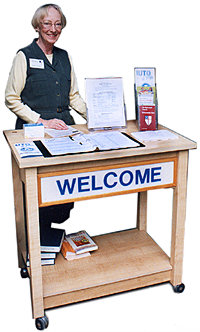
| A welcome table at the Episcopal Church of the Resurrection in
Longwood, Fla. Photos by Joe Thoma |
"About 75 percent of new members over the last three years have
some kind of downtown connection [through the parish's outreach
ministry]," says the Rev. Randolph Charles, rector.
Jeff Schanz discovered the parish's ministry during his lunch
hour one day. He calls it an offering of peace and refuge to everyone
in the midst of a very busy workday. The former Methodist has
been a member for the last three months, drawn to the parish because
of its inclusivity. "I could receive Holy Communion and did not
have to be Episcopalian," he says. "I then realized that this
is an all-inclusive place, and I would be welcomed."
According to Charles, the parish's welcoming commitment is rooted
in its founding more than 100 years ago, when blacks and whites,
the upper middle class and the poor came together. "It is a dynamic
and diverse congregation made up of unique individuals [who are]
very committed to their faith journey and the growth of a faith
community," says Charles. "There is an openness to look at, be
with and enjoy people who are different than we are."
That opportunity arises each Sunday morning -- before the service
-- at a sit-down breakfast known as the "Welcome Table," in addition
to Bible Study and a self-help group meeting. "There is a great
sense of mutuality and shared ministry between the poor and the
parishioners," says Charles.
A clear, intentional invitation to come to church from a member
of a parish provides an immediate welcome. That is how Joe Wallace,
18, first arrived at Holy Trinity Church in New Orleans: Parishioners
invited his family. Wallace calls their ministry family-oriented,
a real living out of the baptismal covenant.
"It is a place of comfort, and security," he says, "a place to
see God in human beings."
 |
|
|
Making the church easy to approach is an important sign of welcome.
That often means mounting clear signs pointing to the nursery,
the parish hall, the sanctuary. Evangelist Andrew Weeks of The
Magnetic Church, a non-confrontational evangelism program that
helps churches attract and retain new members, points out that
clear signs are the first way parishes can aid young parents concerned
about the religious formation of their children. "Young adults
do not go to church for themselves but for their children," he
says. "Let the mystery be about God, not where the Sunday school
or bathrooms are."
Printing the entire service in the worship bulletin allows for
ease and access, too. That is a technique Smith, rector in Hudson
Ohio, uses. He also encourages parishioners to watch for new members
or visitors having difficulties following the service.
The future of the church and the goal of 20/20 -- doubling church
membership by the year 2020 -- both depend greatly on being welcoming,
according to the Rev. LeeAnne Watkins of the Standing Commission
on Domestic Mission and Evangelism and rector of St. Mary's Church,
St. Paul, Minn.. But, she says, the benefits go further.
"Inviting people into a life with Christ will transform their hearts and therefore their relationships and then certainly the world around them."
|return to top of page |home |contents |archives
|to subscribe |staff-partners |to reach us
|about episcopal life |to advertise |promotions |exit
| Related stories |
| How to be more welcoming |
| Christ Church in Ballston Spa, NY |
| St. Paul's in Riverside, CT |
| Trinity Church in Santa Barbara, CA |
| MAIN STORY |