
|
California church takes hospitality ministry seriously
By DICK SNYDER
IT'S DIFFICULT NOT to feel welcomed at Trinity Church, Santa Barbara, Calif.
Welcoming newcomers is part of an intentional, well-developed method that acquaints visitors with the church and encourages their participation.
"It begins with some core values of the parish," said the Rev. Mark Asman, rector. "The issue of hospitality is an intentional mindset in the parish."
 It
includes the way that visitors are welcomed in the parish office during
the week and the way that telephone calls are answered. "That impression
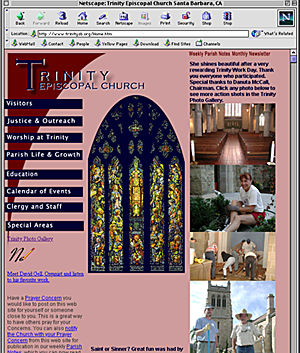
is very important" to visitors, Asman explained. A web site (www.trinitysb.org)
also is used "as a tool for welcoming new people that we didn't expect."
It
includes the way that visitors are welcomed in the parish office during
the week and the way that telephone calls are answered. "That impression
is very important" to visitors, Asman explained. A web site (www.trinitysb.org)
also is used "as a tool for welcoming new people that we didn't expect."
The welcoming process was reviewed at a parish "visioning" meeting, and that has led to a program that incorporates "hospitality beyond welcoming," said Asman. It's a priority of the Parish Life and Growth Council, one of five councils consisting of parish staff and congregational members that coordinate the parish's activities.
"We have a culture of inclusiveness and a shared ministry at Trinity," said Steve Singleton, who chairs the council. "It's what we as a church community think of ourselves. It's important to practice what we preach. We mean to act on what we believe is important."
The parish's mission statement affirms the "value of inclusion and diversity," added Asman. "We are active in justice work in the community and have a progressive agenda. People come here for that."
Visitors at worship are welcomed by greeters, who are identified. "We try not to attack [visitors] but let them know they are welcome," said the Rev. Anne Howard, associate rector.
The bulletin for the 10 a.m. service every Sunday includes all the words used in the liturgy and the hymns. "The Book of Common Prayer is not very user-friendly for first-time worshipers," explained Asman.
"There is intent to have an absolutely open Eucharist," he added. Both the bulletin and announcements during the worship state that the Eucharist is open to everyone, "wherever they are on their faith journey."
Following worship, there is a welcome table and a resource table, where visitors can sign up for parish classes. There is a half-hour program each Sunday, which in a four-week cycle covers the gospel as lived out at Trinity, a discussion of the shared-ministry program, a discussion of the formation program and a tour of the church facilities.
New members also are encouraged to join an ongoing catechesis class, which is held in small groups and in the homes of church members. The classes allow new members to meet and share with other members of the congregation.
"It's a way for people who have trouble being heard to find a way to enter into being heard," said Asman.
New members also have the opportunity to meet with a staff member to explore what gifts for ministry they bring and how they could be put to use within the worshiping community.
"Shared ministry is taken seriously here," said Singleton. "We work
seriously to discern their gifts for ministry, rather than trying to strong-arm
someone into a particular job."
Added Howard, "We are constantly refining the newcomer process. We
are open to reviewing what works and what doesn't work. We want to make
it more welcoming."
Dick Snyder is western correspondent for Episcopal Life and a seminarian at Church Divinity School of the Pacific in Berkeley, Calif.
|return
to top of page |home
|contents
|archives
|to
subscribe |staff-partners
|to
reach us
|about
episcopal life |to
advertise |promotions
|exit
| Related stories |
| How to be more welcoming |
| Christ Church in Ballston Spa, NY |
| St. Paul's in Riverside, CT |
| Trinity Church in Santa Barbara, CA |
| MAIN STORY |