| |
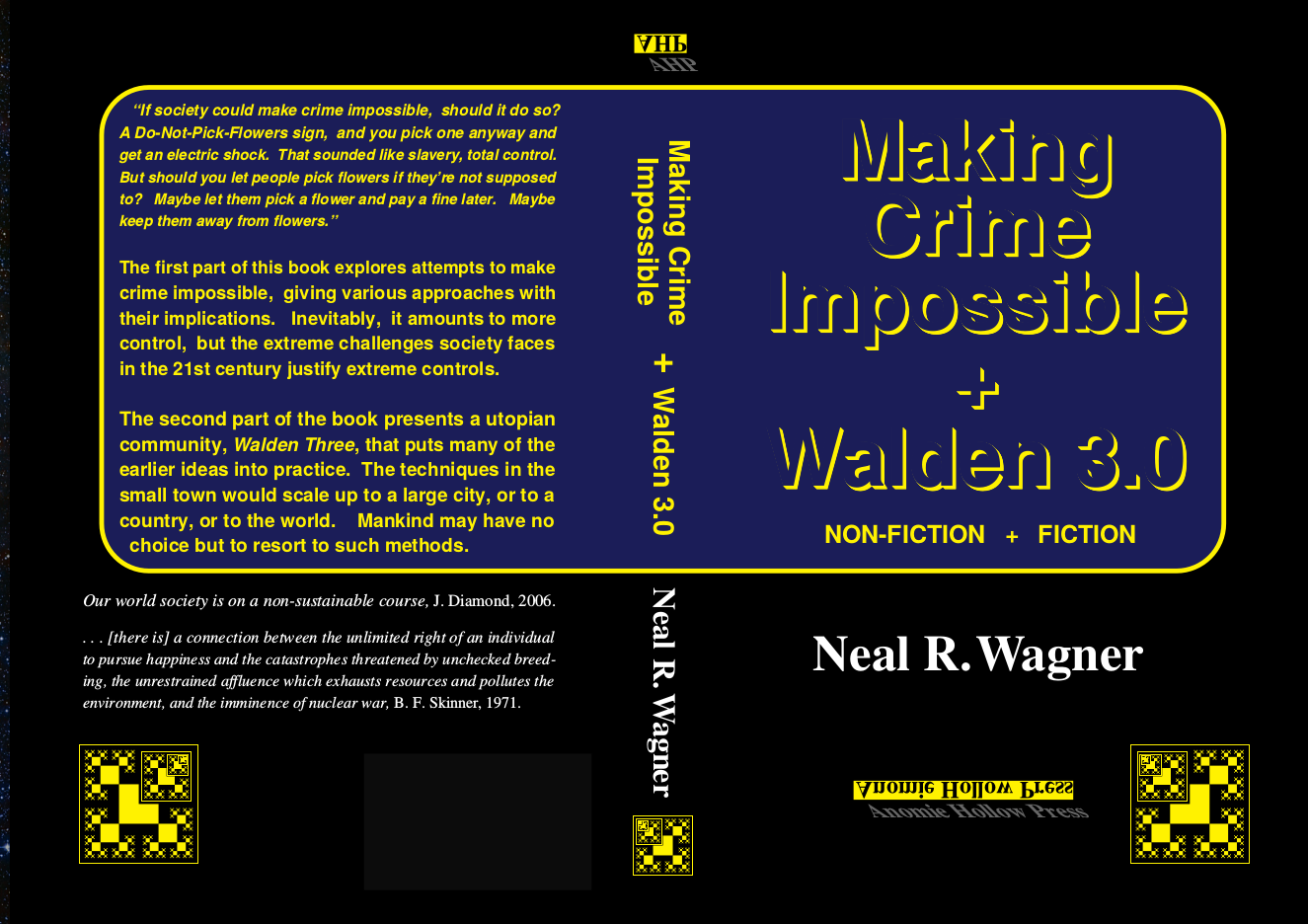
Making Crime Impossible
+ Walden 3.0 |
A Book by |
Neal R. Wagner
|
|
|
Click above for larger image (still only a png),
or here:
Full PDF Image
|
Shortcut for just the novella Walden 3.0.
Takeaways From this Failed Book Project.
If there is anything to be learned, it is embodied in two quotations from
B. F. Skinner's book Beyond Freedom and Dignity, published in 1971.
Our culture has produced the science and technology it needs to save itself.
It has the wealth needed for effective action. It has a concern for its own future.
But if it continues to take freedom and dignity, rather than its own survival,
as its principal value then some other culture may make a greater contribution
to the future. (Page 181)
... it is not difficult to demonstrate a connection between the unlimited
right of an individual to pursue happiness and the catastrophes threatened
by unchecked breeding, the unrestrained affluence which exhausts resources
and pollutes the environment, and the imminence of nuclear war.
(Page 213)
As I write this in 2024,
a future that was clear to Skinner fifty-three years ago is
quickly becoming a horrific reality before our eyes.
In that time the world's population has more than doubled
and climate change, which Skinner didn't know about,
is creating unprecidented problems everywhere
with clear predictions of far worse to come.
Story of a Book.
Here is how this book got started:
During a computer ethics course that
my friend Myles McNally and I were teaching, he mentioned the
phrase "What if crime were impossible?"
It struck me as profound -- these
were magic words, words of power.
This started me on a book-writing project:
Non-fiction to embody the phrase and a
fictional section of a town using these ideas.
B. F. Skinner wrote a very popular book,
Walden 2 that presented a modern society based
on his ideas about psychology, so it was
natural for me to call my own town Walden 3.
The book's title then became Walden 3:
What If Crime Were Impossible?
I had a connection with an MIT Press editor
who was interested in my idea for a book and encouraged
me to pursue it. I spent several years working on
it and finally sent him a draft. He in turn sent
it to several big wheels in computer science, who
gave it negative reviews. So at that press the
project was dead. I tried sending it to a number
of other places with no luck.
My son was working on some creative writing.
One of his contacts read my book. His reviews
included some recommendations for the main part,
but he thought the fictional part needed drastic
improvements. Over time I made these.
Later an actual editor for another press showed interest in my
book, but wanted substantial improvements in the
non-fiction part, including many references.
By the time I'd made all those improvements,
she had moved up in the company, and her replacement
wasn't interested in my book.
Reluctantly, I finally gave up after maybe ten years.
Much later some friends encouraged me to keep trying,
but by then the book was increasingly dated.
My Big MIstakes.
I did sort of know about the first mistake from the
beginning, but I ignored it. It's like a law of nature.
Nobody ever publishes a book with equal parts non-fiction and fiction.
The second mistake had to do with Skinner's book Walden Two,
describing a fictional society based on controlled human behavior.
Skinner wrote this book in 1948. Over time it became extremely popular,
particularly at universities. In 1971 it had its 21st printing.
In order to get it published at all, Skinner had to write a separate
non-fiction book for the same publisher. In the early 1960s my friends
and I read and discussed the book on our own, even though it hadn't been
required for a course.
Even now there are academic study guides to the book and follow-on books,
Actual societies were created modeled after his book.
But by the 1990s when I was writing my book most people had never
heard of Walden Two.
So my book's title, starting with "Walden Three," wouldn't be familiar.
Corresponding Chapters.
My idea was to have each fiction chapter make use of
or have something to do with the non-fiction chapter of the same number.
This was difficult, and I think I was successful.
The Book Itself, Now Our of Date.
Here is the book more-or-less as I was trying to market it twenty-five
years ago. This version has "Walden" removed from the title.
All the fiction is gathered at the end. The table of contents pages
are much improved, showing the correspondence between chapters of
the same number in the fiction and non-fiction.
And here is my recent attempt at a rewrite before I gave up.
Only the Preface and the first part of Chapter 1 are new.
(I deleted all the references.)
I liked my new Preface and I'm fond of the start of Chapter 1,
which exhaustively describes our vulnerable civilization.
Read the Novella
(not quite a Novel): Walden 3.0.
The second part of this book is a short novel that
stands by itself pretty well, even though each chapter matches up
with the earlier part of the book.
(There's also a shortcut just below the main image above to get
to this page.)
(Revision date: 2024-06-29.
Please use ISO 8601,
the International Standard.)
|