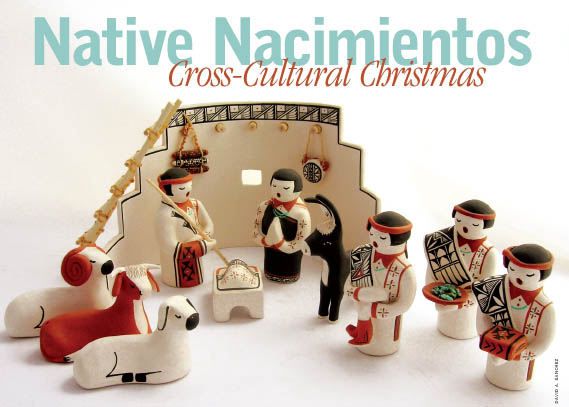
 above: Clay Nativity by Gerti (Mapoo) Sanchez. Photo by David A. Sanchez.
By Gussie Fauntleroy
Throughout the centuries, artists have created Nativity sets—also
called crèches and, in Spanish, nacimientos—in materials and with
figures that reflect their own cultures and times. In the late 1950s
and early 1960s, Native artists of New Mexico began making full crèche
sets, complete with the Holy Family, animals, and Wise Men bearing
gifts such as corn, frybread and Pueblo pots, according to Doris and
Guy Monthan, author and photographer of the seminal history of the
genre, Nacimientos: Nativity Scenes by Southwest Indian Artisans. When
collectors, including major folk art collector Alexander Girard,
discovered these Pueblo- and Navajo-style figures in clay and wood—and
later stone and other media—the art form quickly spread and became a
movement.
It’s a movement with deep roots in the figurative traditions of several
of the pueblos, and it reveals the complex and unique melding of Pueblo
traditions and rituals of the Catholic Church. It also reflects the
custom, practiced at all New Mexico pueblos, of celebrating not only
Christmas but also Kings’ Day, the January 6 feast day in honor of the
three Wise Men.
Tesuque Pueblo potter Manuel Vigil (1910–2003) is said to have been the
first Southwest Native to create a full Nativity set, in 1959, at the
suggestion of Sallie Wagner of Santa Fe. Soon others—including Navajo
Tom Yazzie, Helen Cordero and Seferina Ortiz of Cochiti Pueblo, and
Alfred Aguilar of San Ildefonso Pueblo—were refining and spreading the
genre. Today many fine artists create Nativity sets; here are several
of the best. Of those who work in clay, all use traditional Pueblo
methods, including gathering and preparing local clay, painting with
natural pigments, and firing outdoors.
Mary Trujillo
Mary Trujillo learned to make red and black pottery at her home pueblo
of Ohkay Owingeh (formerly San Juan Pueblo). After marrying, she moved
to her husband’s home at Cochiti Pueblo and learned to use Cochiti clay
and designs. Although Trujillo’s mother-in-law was famed artist Helen
Cordero, who is credited with establishing the storyteller genre,
Trujillo says she was more directly influenced by her friendship with
Cochiti potter Ada Suina. “Ada taught me how to build a storyteller,
and I thought up my storyteller’s own face: I did my grandfather from
Ohkay Owingeh, with a black hat and braids,” the 70-year-old artist
explains.
Trujillo’s larger Nativity sets include two eagle dancers and two
singers with drums, while the Wise Men often carry bows and arrows. The
artist’s husband, Leonard Trujillo, who also helps gather and prepare
clay and fire the pieces, makes the wooden bows, arrows and drums.
Trujillo’s award-winning work is available by special order, by calling
her at 505/465-0398.
Troy Sice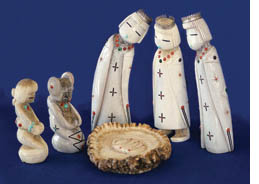
Elk antler set by Troy Sice inlaid with
semi-precious stones. Photo courtesy Andrews Pueblo Pottery.
Fetish carver Troy Sice reaches back to a prehistoric Zuni Pueblo
tradition in the use of antler for creating animal and human forms.
Coming from a large family of jewelry makers and carvers, he combines
skills from both types of art: he sculpts in antler and adorns his
figures with inlaid stone and shell. The 30-year-old artist grew up at
Zuni Pueblo and learned to carve by watching his older siblings. Now
living in Albuquerque, he works in elk antler, which allows his work to
range from two inches to four feet tall.
In Sice’s Nativity sets—whose tallest figures, the Wise Men, are not
quite six inches—faces and other details are finely etched, while color
is added in hand-cut inlays of turquoise, malachite, lapis, red coral
and other natural shell and stone. “As an artist,” he says, “I’m always
exploring.” His work is on view at Andrews Pueblo Pottery in
Albuquerque.
Paul and Dorothy Gutierrez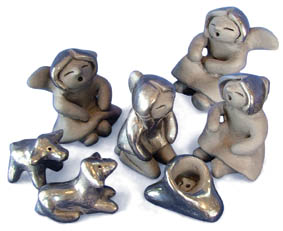
Paul and Dorothy Gutierrez, husband-and-wife artists from Santa Clara
Pueblo, were among the first potters at Santa Clara to create Nativity
sets. Paul is from a family of well-known potters, among them his
father and aunt, Luther and Margaret Gutierrez. Dorothy, who is Navajo,
learned the art from Paul’s relatives. The couple is also known for
their award-winning animal figures and storytellers. They began making
Nativity sets in about 1970.
right: Traditionally coiled and fired clay Nativity by Paul and Dorothy
Gutierrez. Photo courtesy Andrews Pueblo Pottery.
Paul and Dorothy work as a team, with Dorothy forming the figures and
Paul doing the polish and finish work. Every step, from gathering clay
to firing outside, follows traditional Santa Clara methods. Their
redware and blackware Nativity sets contain as many as 17 figures and
range from miniature to six inches tall. “They come out different each
time, with different faces. It’s nice,” Paul relates. Their work is
available at Adobe Gallery in Santa Fe, Andrews Pueblo Pottery in
Albuquerque and Buffalo Dancer in Taos, among other galleries, or you
can contact them at 505/753-2890.
Gerti (Mapoo) Sanchez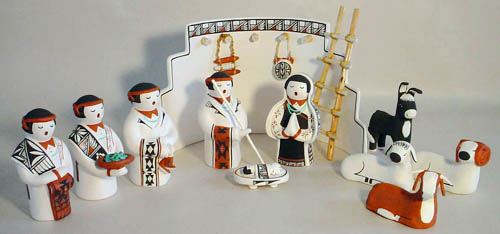
Isleta Pueblo artist Gerti Sanchez, who signs her work with her Isleta
name, Mapoo (“corn silk”), incorporates a Pueblo-style backdrop into
each of her Nativity sets. A curved clay wall, sometimes with vigas
(wooden beams) and a ladder made of river willow, stands behind the
Holy Family. In larger sets, a tiny clay water jug (olla) and ears of
corn may hang from the vigas. “I try to make them in the true Isleta
style, with respect to my traditions and culture,” Sanchez explains.
The 48-year-old artist taught herself to work with clay as a young
woman. She was guided in the process by her grandmother and aunt, who
in the 1920s and ’30s made pottery to sell at railroad tourist stops.
Sanchez’s award-winning work is known for its fine painting; her
Nativity figures wear traditional Isleta clothing and hold blankets
adorned with Pueblo designs. The figures’ mouths are open, she notes,
“as if in prayer.” Sanchez’s work can be found at Susan’s Christmas
Shop in Santa Fe and R.C. Gorman/Nizhoni Galleries in Albuquerque, or
by calling 505/898-5578.
Wilson Romero
below: Stone set
carved by Wilson Romero. Photo courtesy Andrews Pueblo Pottery.
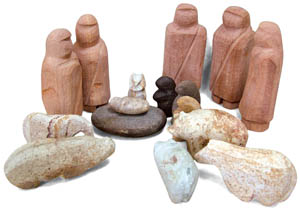
Wild and domestic animals of all kinds quietly surround the Holy Child
in Nativity scenes by Cochiti Pueblo stone carver Wilson Romero.
Mountain lions, groundhogs, horses, eagles and owls are among the
simple yet engaging animal forms Romero sculpts from common rocks he
finds along the river or in the foothills near his home.
The 64-year-old artist began carving in 1987 after graduating from the
College of Santa Fe and taking jewelry and sculpture courses at the
Institute of American Indian Arts. Although he has worked in many types
of stone, today he carves human figures such as the Holy Family and
Wise Men in sandstone, while animals suggest themselves in small rocks
he finds. “I’m so blessed to be able to pick the rocks and see what
animals they want to become,” he says. Romero’s art is on view at
Andrews Pueblo Pottery in Albuquerque, and at Keshi, Bahti Indian Arts
and Susan’s Christmas Shop in Santa Fe; or contact the artist at
505/269-9415 or via e-mail at wromero_2007@yahoo.com.
Mary Ellen Toya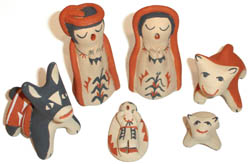 Mary Ellen Toya’s clay set, made of Jemez Pueblo clay. Photo
courtesy Andrea Fisher Fine Pottery.
Mary Ellen Toya’s clay set, made of Jemez Pueblo clay. Photo
courtesy Andrea Fisher Fine Pottery.
Mary Ellen Toya and her seven sisters are carrying on the legacy of
their mother, renowned Jemez Pueblo potter Mary Elizabeth Toya, and
their grandmother, Carrie Loretto of Laguna Pueblo. Perhaps the best
known of the sisters, Mary Ellen Toya has earned awards for her
Nativity figures at Santa Fe Indian Market. With eyes prayerfully
closed, the figures are masterfully painted in Jemez-style clothing and
designs.
The Toya sisters’ creation of Nativity sets reflects a longtime
practice at Jemez Pueblo of melding Christian and ancient Native
traditions, especially around the birth of Jesus. Each year a Pueblo
home hosts a live Nativity scene for two weeks, with traditional dances
and food. “I love making Nativity sets because they talk about God,”
Toya reflects. “We really are grateful for what we have here in Jemez.”
Toya’s work is available at Andrea Fisher Fine Pottery and Susan’s
Christmas Shop in Santa Fe and at the Christmas Shop in Albuquerque;
contact Toya at 505/263-4125.
Harry Benally
In Harry Benally’s Nativity sets, the infant Jesus lies snugly in a
cradleboard and one of the Kings’ gifts is a sack of Bluebird flour—so
Mary can make frybread. “Everything I do has to do with the Diné
(Navajo) way of life after the Long Walk,” explains Benally, a Diné
woodcarver from Sheep Springs, New Mexico. The 57-year-old artist
remembers how people on the reservation dressed when he was growing up,
with hair buns and velvet shirts. So that’s how his Nativity figures
look.
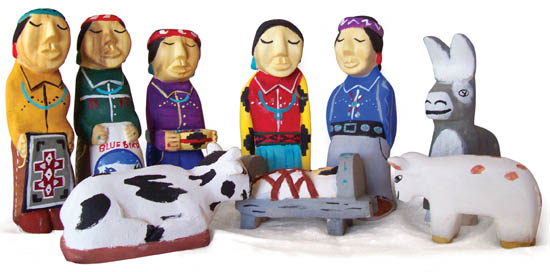 Harry Benally’s Nativity is carved from local wood then hand
painted by his wife. Photo courtesy The Christmas Shop In Old Town.
Harry Benally’s Nativity is carved from local wood then hand
painted by his wife. Photo courtesy The Christmas Shop In Old Town.
Benally’s first Navajo-style carving, inspired by his mother, was
called Diné Lady, which is also the name of his art business. Some of
his six-inch- to five-foot-tall Nativity figures, with eyes reverently
closed, are carved in cottonwood root and sanded and painted in fine
detail by his wife, Isabelle. With other sets, Benally burns the
designs into oiled, unpainted juniper wood. His work is on view at the
Christmas Shop in Albuquerque and at dinelady.com.
Mary Lucero
Faces raised, mouths open and expressive eyes looking heavenward, the
Holy family and Wise Men seem to be prayerfully singing in the Nativity
sets by Jemez Pueblo clay artist Mary Lucero. Even the baby Jesus is
kicking and raising his arms. Lucero, 59, is known for the exceptional
painting on her figures, which range from miniature to six inches. The
kneeling figures are painted with turquoise necklaces and Pueblo-style
clothes.
Lucero, who also creates storytellers, has been working in clay since
the mid-1980s, having learned the art from a sister-in-law. She began
by making pots, but soon realized she much prefers forming and painting
figures. “I sit down and pick up the clay, and I want them to be
perfect,” she says. “When I’m done I say to myself, ‘Whoever buys this,
I hope they will enjoy it.’” Lucero’s work is available at Wadle
Galleries, Santa Fe; Andrews Pueblo Pottery and Southwest Pottery,
Albuquerque; and Six Directions, Taos.
Betty and Robert Naranjo
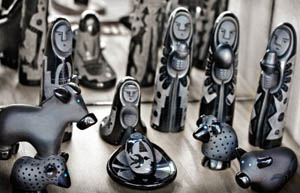
Traditional Pueblo designs are delicately etched into all sides of
Betty and Robert Naranjo’s blackware Nativity figures. This year the
award-winning artists, both from Santa Clara Pueblo, added another
original touch, a circular mirror behind the figures so viewers can see
the sun, rain, lightning, Pueblo dancers, and other symbols finely
etched into the figures’ backs. One more distinctive feature: the
animals attending the Holy birth have turquoise eyes.
Etched blackware Nativity by Betty and Robert Naranjo. Photo by Paula Couselo-Findikoglu.
Watching his parents and grandparents, Robert began working with clay
as a young boy. Betty was inspired to learn after she and Robert were
married in 1978. She gained pottery skills—and well-used polishing
stones—from her grandmother and mother. Robert forms the figures, Betty
polishes them, and after firing, Robert meticulously etches the
designs, using power and hand-tools. “It’s gratifying because each face
has its own expression,” he observes. The work is time-consuming, so
the Naranjos create just a couple of Nativity sets, by special request,
each year. They may be reached at 505/753-3341.
Santa Fe–based writer Gussie Fauntleroy contributes to national and
regional publications on subjects of art, architecture and design. She
is the author of three books on visual artists, including Roxanne
Swentzell: ExtraOrdinary People.