| "It is good that you are throwing light on Harry Potter, because these are subtle seductions that work imperceptibly, and because of that deeply, and erode Christianity in the soul before it can even grow properly." (From a 2003 letter, quoted in Newsweek, 25 July 2005) |
This doesn't explain the nature of his objections, which are perhaps based more on the "occult" in the series than on the violence.
Whatever the objections are to the magic and violence in the Harry Potter series, similar ones should also apply to other standard fantasy series, such as the Narnia novels of C.S. Lewis or the Lord of the Rings trilogy of J.R.R. Tolkien, or to a host of other fantasy works, including books, comic books, movies, television shows, video games, and others. They all of them involve very strong elements of magic and violence. Most parents encourage their children to read the Narnia series, even though the books are full of magic and violence, because of the strong Christian themes and the clear moral tone in these books. Tolkien's books are also often supported, but the Harry Potter series is more controversial. It's not just the Pope who disapproves, but whole books have been written about the dangers to children of Harry Potter. For example:
Harry Potter and the Bible: The Menace Behind the Magick by Richard Abanes, 275 pages. This book is actively hostile to the Harry Potter series, with reviewers saying: "Abanes charges that Harry doesn't suffer consequences for his actions and that he acts only out of self-interest." or that "Abanes charges the books with humor that borders on perversity ... [that] the books center around the promotion of what he terms "magick" (occultism, including astrology, divination, fortune-telling, etc.)."
Other books written from a Christian perspective are very favorable to the Harry Potter series, such as:
What's a Christian to do with Harry Potter? by Connie Neal, 210 pages. The author is a conservative Christian who believes in a real Satan and in real "occult influences" in the world. However, she's a big fan of the series and wrote a whole book to prove it. She says that children like the books because of the way they appeal to the kids' "heartfelt needs," such as empowerment, to be strong, rich, successful, famous. To belong. Empowering factors in the books are magic, secrets, icons, and knowledge. They foster kids' "desire to be the best they can be," they "appeal to kids' thrill in victory" and to their "deeply felt emotions." They help kids conquer their fears.
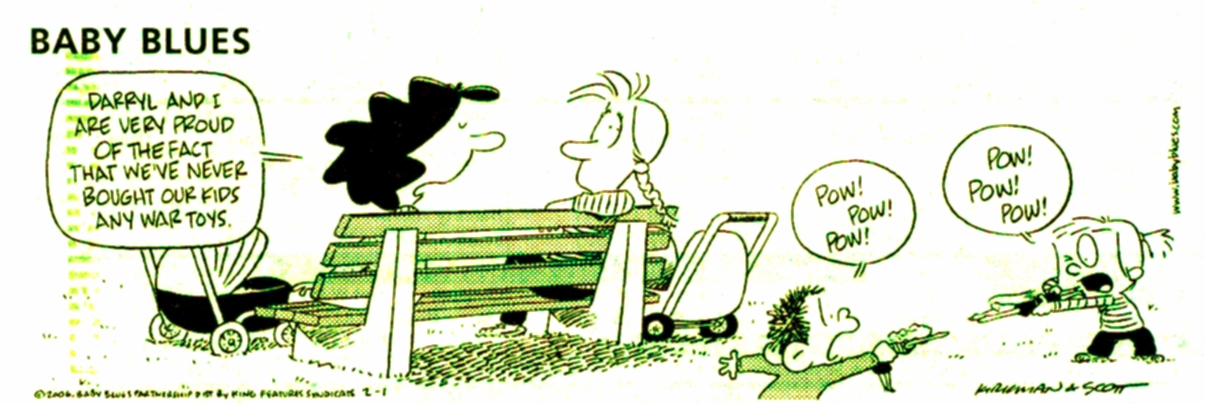
In studying this area, I've shifted my attention from the magic to the violence.
Killing Monsters: Why Children Need Fantasy, Super Heroes, and Make-believe Violence, by Gerard Jones, 261 pages. Jones is a former comic-book and screen writer who has extensive experience with psychologists, educators, parents, and children. Jones runs his Art and Story Workshops for children and adolescents, where he encourages children to write and illustrate their own fantasy stories. He has become convinced that "validating children's fantasies teaches our kids to trust their own emotions, build stronger selves, and withstand the pressures of pop culture -- and that attacking or trying to eliminate them only increases the media's potential negative effects." (From the flyleaf.)
Here is an outline of this book based on a few chapters:
Jones: "I gathered hundreds of stories of young people who had benefited from super-hero comics, action movies, cartoons, shoot-'em-up video games, and angry rap and rock songs. I found stories of kids who'd used them badly, too, and others who needed adult help to use them well. But mostly I found young people using fantasies of combat in order to feel stronger, to access their emotions, to take control of their anxieties, to calm themselves down in the face of real violence, to fight their way through emotional challenges and lift themselves to new developmental levels."
|
For Aristotle, the purpose of tragedy is to purge the emotions
of pity and fear that are aroused.
Aristotle describes catharsis [Greek Katharsis:
cleansing] as this purging.
In this way tragedy relieves viewers of harmful emotions,
leaving them better people for their experience. (Larry A. Brown,
rewritten) "A perfect tragedy should imitate actions which excite pity and fear. The change of fortune presented must not be the spectacle of a virtuous man brought from prosperity to adversity, for this merely shocks us. Nor that of a bad man passing from adversity to prosperity, for this neither satisfies the moral sense, nor calls forth pity and fear. Nor, again should the downfall of the utter villain be exhibited. This would doubtless satisfy the moral sense, but it would inspire neither pity nor fear; for pity is aroused by unmerited misfortune, fear by the misfortune of a man like ourselves. There remains a man who is not eminently good and just, yet whose misfortune is brought about not by vice or depravity, but by some error or frailty." (Aristotle, Poetics, Part XIII, shortened) "In the tenth book of Plato's Republic Socrates enunciates his theory that poetry is an imitation (mimesis) of reality, and on this basis he develops his rule about which artists should be allowed into the ideal state (namely, only those who imitate noble actions). This idea of imitation is taken up by Aristotle in his Poetics, who holds that the ideal work of art should be the expression of what it seeks to represent or imitate, yet Plato's idea of imitation (that seeing bad actions inspires people to act badly) is opposed to Aristotle's notion of catharsis (that seeing bad actions frees one from the desire to act badly)." (R. D. Griffith) |
|
38 Then Saul dressed David in his own tunic.
He put a coat of armor and a bronze helmet on him. 39 David fastened on his sword over the tunic and tried walking around, because he was not used to them. "I cannot go in these," he said to Saul. 40 Then he took his staff in his hand, chose five smooth stones from the stream, put them in the pouch of his shepherd's bag and, with his sling in his hand, approached Goliath. 42 Goliath looked David over and saw that he was only a boy, and he despised him. 43 He said to David, "Am I a dog, that you come at me with sticks?" And he cursed David by his gods. 48 As Goliath moved closer to attack him, David ran quickly toward the battle line to meet him. 49 Reaching into his bag and taking out a stone, he slung it and struck Goliath on the forehead. The stone sank into his forehead, and he fell facedown on the ground. 50 So David triumphed over Goliath with a sling and a stone; without a sword in his hand he struck down Goliath and killed him. 51 David ran and stood over him. He took hold of Goliath's sword and drew it from the scabbard. After he killed him, he cut off his head with the sword. (1 Samuel, shortened and edited) |
I want us to tell our children all the great stories in the bible, including especially the parables of Jesus. But I think they will have to grow up to truly appreciate Jesus as a great hero of a very different sort from fantasy super heroes.
Even some adults, including self-styled Christian ministers fail to understand that fantasy violence can be a way to cope, and that real violence is an abberation.
|
"Armageddon, the world's most natural battlefield, will be
bathed in blood. The Bible has predicted it, down to the
length of the battlefield. Mark my words, this battle of
unsurpassed carnage is not a fable, it is a fact -- and every
tick of the clock brings us closer to it. The crowning event of this battle occurs when the Antichrist, who believes he can defeat God Almighty, will gather his forces to face a heavenly army led by the Messiah Himself." (Beginning of the End, by John Hagee, Chapter 9) |
This is Hagee's idea of Christ "coming again in glory." Instead, Jesus's attitude toward violence is partly shown by his call to love one's enemies. It's a paradox: he who loves his enemies has no enemies. And you don't use violence against those you love.